

The 'Intent' Shield: Decoding the Supreme Court’s New Barrier to Voting Challenges
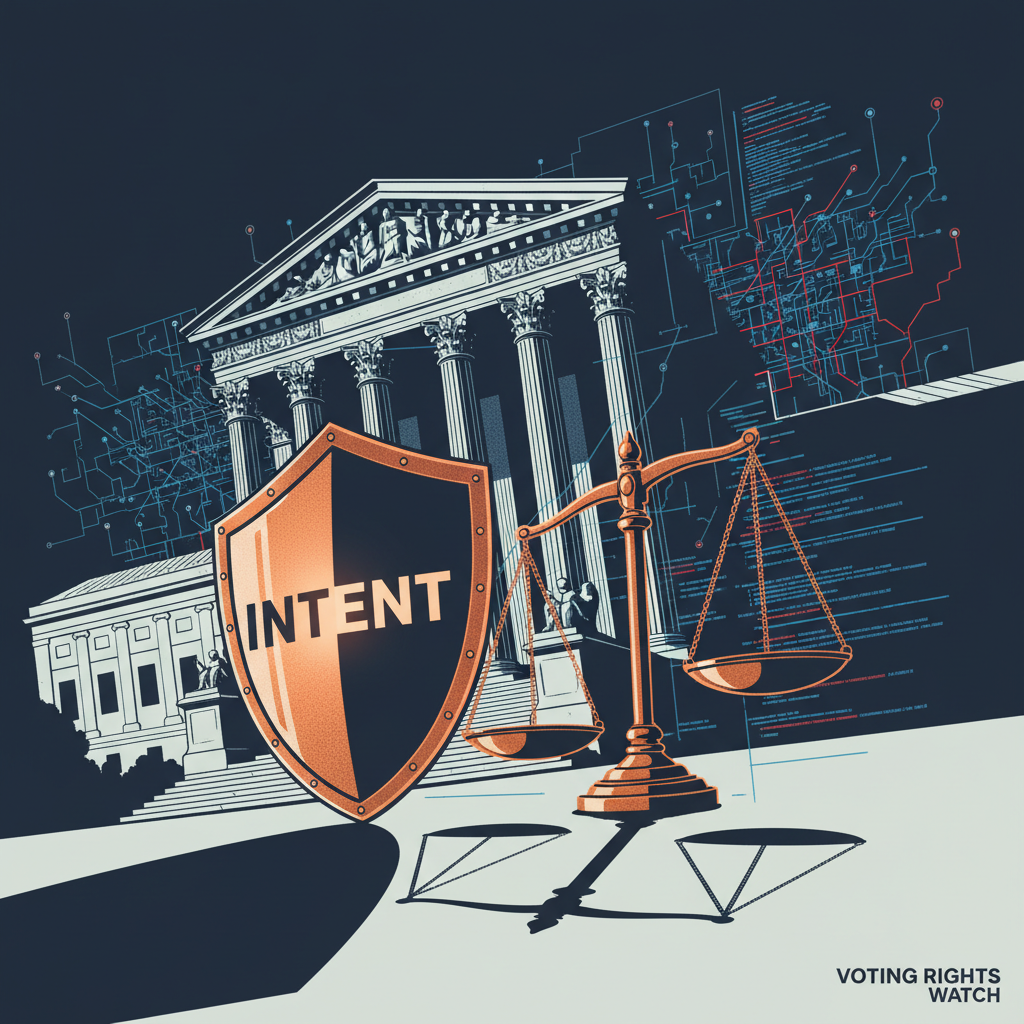
Mainstream reporting on the Supreme Court’s 6-3 decision regarding Louisiana’s congressional maps has largely centered on a narrative of judicial finality. By framing the ruling as a 'final blow' to the Voting Rights Act (VRA), outlets like the New York Times have traded rigorous legal analysis for dramatic headlines. This framing suggests an irreversible ending, which obscures the mechanical shift the Court actually performed: moving from an 'effects-based' standard to an 'intent-based' standard. This change isn't just a procedural tweak; it is a fundamental reconfiguration of the burden of proof that favors institutional power over individual litigants.
What We Know
While the press focused on the immediate political fallout for the 2026 midterms, it largely ignored the strategic pivot away from the Court’s own 2023 precedent in Allen v. Milligan. In that case, the Court upheld the necessity of a second majority-Black district in Alabama based on the results of the map—the 'effect.' Less than two years later, this new ruling essentially renders Milligan a dead letter without explicitly overturning it. By shifting the requirement to proving 'discriminatory intent,' the Court has created a legal standard that is functionally impossible to meet in an era of data-driven redistricting.
Furthermore, much of the coverage exhibits a classic deference to judicial authority. By presenting the 'intent test' as a neutral evolution of law, the press participates in 'access journalism'—echoing the majority's written opinion as if it were an objective reality rather than a specific ideological choice. There has been almost no scrutiny of the coordinated legal strategy involving multi-state litigation funded by non-disclosed donors that brought this specific 'intent' argument to the forefront.
FAQ
Q: How does this ruling reconcile with the 2023 'Allen v. Milligan' decision?
A: The Court has not reconciled them; it has bypassed them. Milligan affirmed that Section 2 of the VRA focuses on the results of redistricting. The new Louisiana ruling pivots to motive. By not formally overturning Milligan, the Court avoids the public outcry associated with reversing recent precedent while simultaneously ensuring that, in practice, the Milligan standard no longer applies to future challenges. This creates a bifurcated legal reality where the VRA exists on paper but is unenforceable in the courtroom.
Q: What specific evidence of 'intent' does the Court now require?
A: The ruling remains dangerously vague on what constitutes 'intent.' In modern legislating, 'smoking gun' memos or recorded statements of racial animus are virtually non-existent. Legislatures now use sophisticated algorithms to achieve partisan ends that happen to correlate perfectly with racial demographics. Under this new standard, if a legislature can claim a 'partisan' motive—which is currently legal—it serves as a total shield against claims of racial discrimination, regardless of the map’s actual impact on voters.
Q: Which organizations and donors funded the litigation path to this test?
A: This ruling was not an isolated event but the culmination of a decade-long strategy by groups such as the Honest Elections Project and various iterations of the Federalist Society’s network. These entities have spent millions to move the judiciary toward a 'colorblind' interpretation of the Constitution that treats any consideration of race—even to remedy proven disenfranchisement—as a violation of the 14th Amendment. By ignoring the funding and the 'strategic litigation' aspect, the press treats the case as a spontaneous legal dispute rather than a planned institutional assault.
What's Actually Happening
The transition from 'effect' to 'intent' is the most significant structural change to voting law in a generation. It moves the legal battleground from the tangible—voter data and map geometry—to the internal psyche of state legislators.
What this story actually means is the end of the VRA as a tool for proactive litigation. When the legal standard requires proving what is inside a legislator’s mind, the court is effectively closing its doors to civil rights challenges. The immediate redrawing of maps in Florida and other states isn't a 'reaction' to the ruling; it is the execution of a pre-planned strategy that was simply waiting for the Court to provide the necessary legal cover. The 'intent test' is the shield that makes the partisan gerrymander invincible.
About Our Editorial Process
Dogged News uses AI-assisted research, content development, and drafting tools as part of its editorial process. Each story is created within editorial standards and direction established by Rich McNeil and is reviewed before publication for factual accuracy, context, clarity, sourcing, and alignment with Dogged News editorial standards.
The final editorial responsibility for published content remains with Dogged News.
Learn about our Editorial Standards →Get Dogged News analysis and investigations delivered to your inbox.
Discussion (0)
0/2000 · Comments are reviewed before publishing.
Have an account? to comment with a verified identity.
No comments yet. Be the first to share your perspective.