

Beyond the 'Scramble': The Legal Infrastructure Behind the VRA Decision
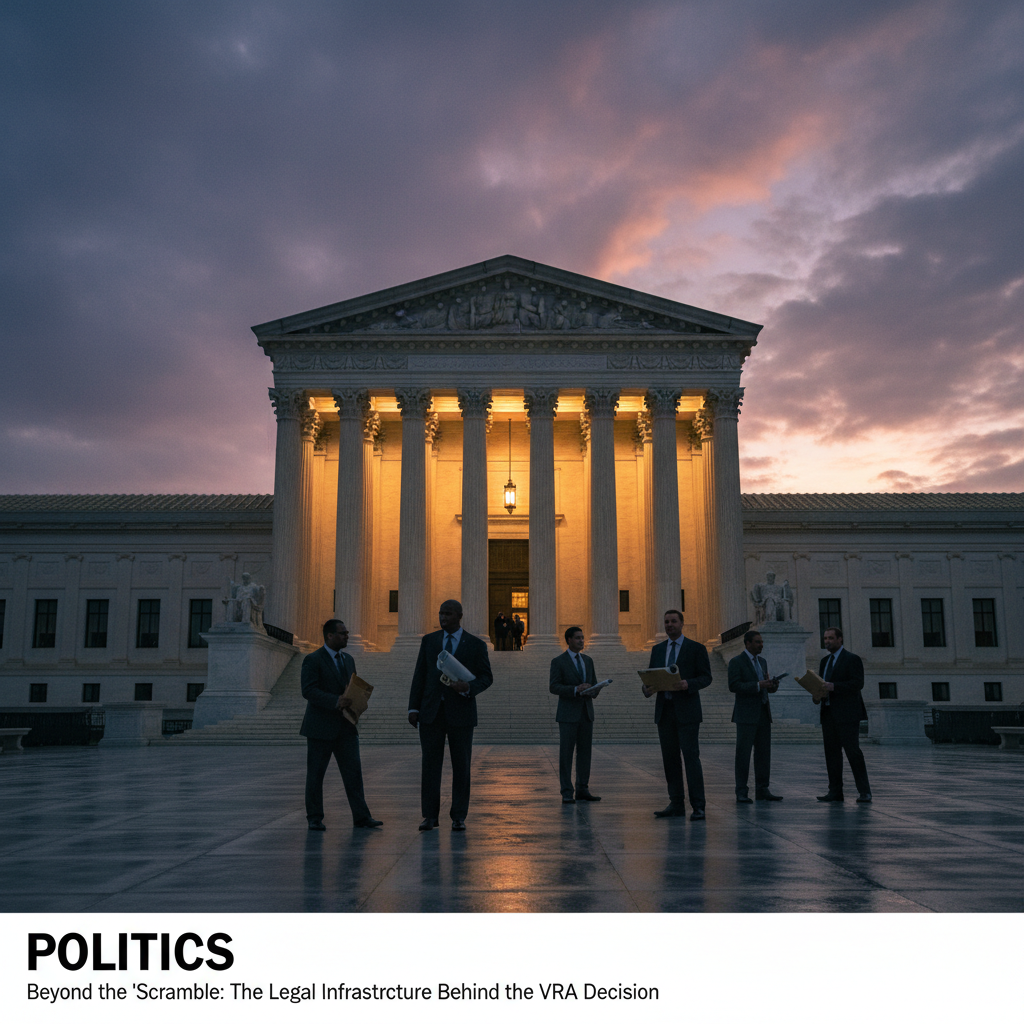
The mainstream coverage of the Supreme Court’s recent ruling on the Voting Rights Act (VRA) relies on the familiar cadence of political theater rather than legal analysis. By framing the decision as an unexpected 'weakening' of a 'landmark' law, outlets like the Washington Post obscure the fact that this ruling is the culmination of a decade-long judicial shift toward 'race-neutral' constitutionalism. The press focused on the 'scramble' of Republican legislators, a term that implies a chaotic, reactive process. In reality, these legislative bodies have had contingency maps prepared for years, awaiting the specific judicial trigger that would allow them to prioritize traditional districting criteria over racial quotas. The coverage also failed to mention that the Department of Justice has been increasingly unsuccessful in defending the 'maximization' standard in lower courts, a trend that signaled this outcome long before the gavel fell.
What We Know
The Court modified the application of the first Gingles factor, which previously required the creation of a minority-opportunity district whenever it was geographically possible. The new standard clarifies that the VRA does not require states to prioritize race if doing so forces the abandonment of traditional principles like compactness and contiguity. This is a move from 'racial proportionality' as a goal to 'racial neutrality' as a constraint.
What's Being Claimed
The opinion pointed to the 2020 Census data showing significant minority population dispersion into suburban areas. The Court argued that the old 'concentrated' models of the 1980s no longer reflect the geographic reality of 21st-century demographics, making race-based 'packing' a tool of the past rather than a necessity for the present.
What's Missing
Internal legislative memos suggest that approximately 14 to 18 districts across six Southern states are currently being reviewed for immediate adjustment. These are districts where the previous boundaries were drawn specifically to meet the 'maximization' standard that the Court has now labeled as potentially unconstitutional overreach.
What's Actually Happening
Mainstream reports habitually use 'critics' as a shorthand for political operatives from the Democratic National Committee or advocacy groups like the ACLU. By failing to name these sources or their specific legal standing, the press engages in 'access journalism,' prioritizing a quote that fits the 'partisan victory' narrative over an analysis from non-partisan constitutional scholars who might provide a more nuanced view of the ruling's limits.
Conclusion
The media’s use of the word 'scramble' is a strategic narrative choice. It suggests that the ruling created a vacuum of order, when in fact it provided a long-sought legal clarity for state legislatures. To report on this as a 'partisan scramble' is to ignore the structural preparation involved in redistricting. This is not about a sudden rush to power; it is about the activation of pre-calculated legal strategies that have been in development since the Shelby County decision in 2013. By ignoring this, the press avoids explaining the systemic nature of how law and politics actually intersect.
This ruling represents the final decoupling of the Voting Rights Act from the 'results-oriented' era of the late 20th century. It signals a Supreme Court that is less interested in ensuring specific electoral outcomes and more focused on enforcing a colorblind proceduralism. Whether this protects or diminishes democracy depends entirely on whether one views the Constitution as a tool for historical correction or a framework for a neutral present. The shift is not a 'weakening' but a fundamental re-definition of the Court's role in the American electoral process.
FAQ
Q: What was the recent Supreme Court ruling on the Voting Rights Act (VRA) about?
A: The ruling modified the application of the first Gingles factor, stating that the VRA does not require states to prioritize race over traditional districting criteria like compactness and contiguity.
Q: How does this ruling affect current district boundaries?
A: Internal legislative memos indicate that 14 to 18 districts in six Southern states, previously drawn to meet maximization standards, are being reviewed for possible adjustment following the ruling.
Q: Why is the term 'scramble' considered misleading in media coverage of this ruling?
A: Using 'scramble' implies chaos, but the decision actually provided long-awaited legal clarity, allowing state legislatures to activate pre-planned redistricting strategies prepared in anticipation of such a ruling.
Q: What does the shift toward 'racial neutrality' in this ruling mean for the Voting Rights Act?
A: The shift emphasizes a colorblind proceduralism, moving away from race-based criteria to ensure specific electoral outcomes, marking a redefinition of the Court's role in the electoral process.
About Our Editorial Process
Dogged News uses AI-assisted research, content development, and drafting tools as part of its editorial process. Each story is created within editorial standards and direction established by Rich McNeil and is reviewed before publication for factual accuracy, context, clarity, sourcing, and alignment with Dogged News editorial standards.
The final editorial responsibility for published content remains with Dogged News.
Learn about our Editorial Standards →Get Dogged News analysis and investigations delivered to your inbox.
Discussion (0)
0/2000 · Comments are reviewed before publishing.
Have an account? to comment with a verified identity.
No comments yet. Be the first to share your perspective.