

The Warsh Confirmation: Beyond the Partisan Noise of 'Fed Independence'
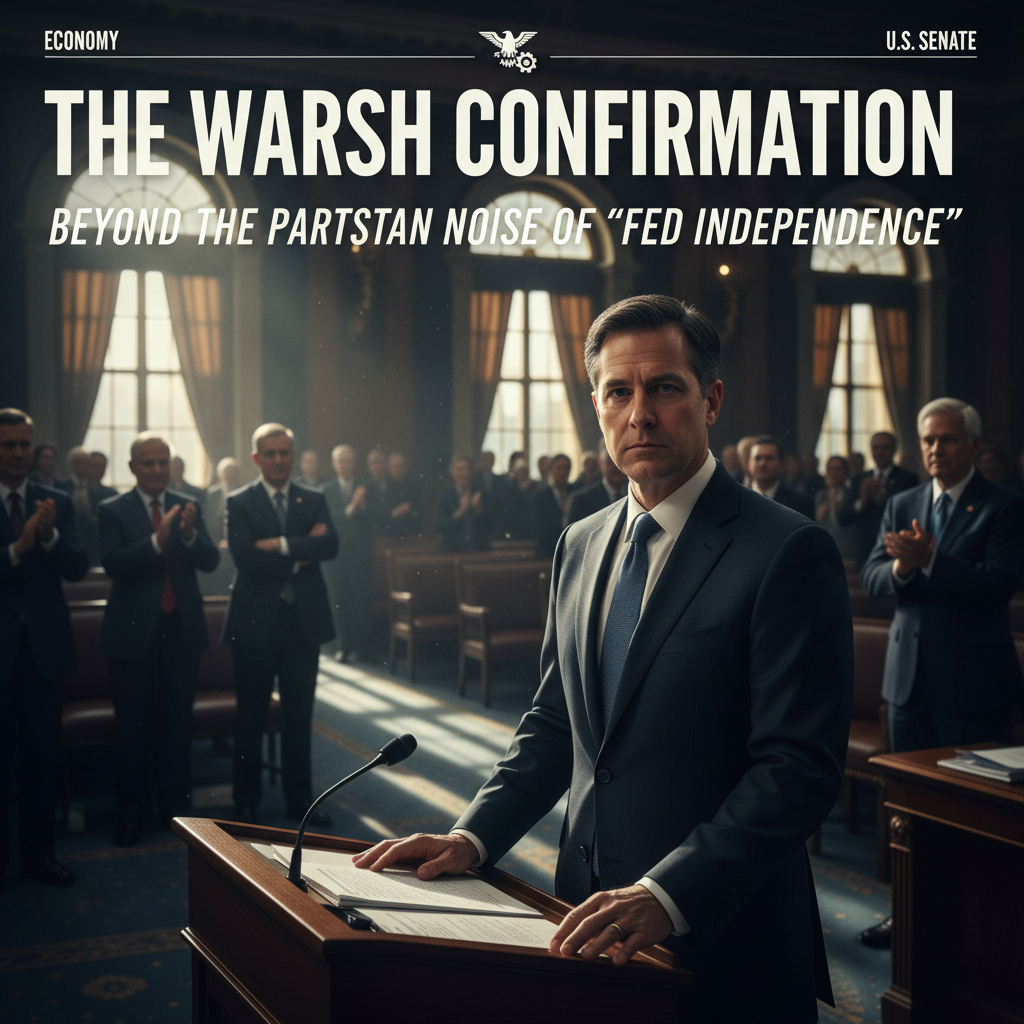
Mainstream coverage of Kevin Warsh’s confirmation to the Federal Reserve chairmanship has largely followed a predictable script: the 'horse race' of a 54-45 partisan vote and the abstract concern over 'political independence.' By focusing on the tally in the Senate, legacy outlets like Reuters have practiced a form of access journalism—prioritizing the optics of the confirmation process over the tangible economic shifts that Warsh’s leadership will likely trigger. What the press missed is that 'independence' is often a rhetorical shield used to mask the Fed’s deep-seated alignment with specific financial interests. The real story isn't that Warsh might listen to the White House; it’s that his policy history suggests a fundamental pivot in how the Fed views its role as a regulator of the world's largest financial institutions.
What's Being Claimed
The term 'deregulation' is frequently used as a political pejorative, but in the context of Warsh’s appointment, it has a very specific target: the Basel III Endgame. These international standards require banks to hold more capital to guard against market shocks. Warsh has historically argued that excessive capital requirements stifle liquidity and hinder the global competitiveness of U.S. banks. While the mainstream media frames this as a 'Trump agenda,' it is more accurately viewed as a victory for the G-SIBs (Global Systemically Important Banks) like JPMorgan Chase and Goldman Sachs, who have lobbied intensely to see these requirements diluted. The question isn't whether Warsh is 'independent' from the President, but whether the Fed under his tenure will become a more permissive partner to Wall Street.
What's Missing
Mainstream reporting often ignores a nominee’s voting record in favor of their recent political associations. During his previous tenure on the Federal Open Market Committee (2006-2011), Warsh was a notable 'hawk,' expressing early concerns about the inflationary risks of the Fed’s massive bond-buying programs (Quantitative Easing). However, his hawkishness was tempered by a willingness to provide extraordinary liquidity to the banking sector during the 2008 crisis. This suggests a dual-track philosophy: a hard line on consumer-facing inflation but a soft touch regarding the balance sheets of major financial intermediaries. Investors should expect a Chair who is willing to tolerate higher interest rates for longer while simultaneously stripping away the 'frictional' costs of bank oversight.
What's Actually Happening
The Reuters report, like many of its peers, treats the Fed’s independence as an objective, historical constant. This is a failure of reporting. From Lyndon Johnson literally shoving Fed Chair William McChesney Martin against a wall to Richard Nixon’s overt pressure on Arthur Burns to keep rates low before the 1972 election, the Fed has always operated within the gravity of the executive branch. By framing Warsh’s appointment as a unique threat to a 'neutral' tradition, the media avoids the harder conversation: that the Fed’s mandates (stable prices and maximum employment) are inherently political choices that favor different economic classes at different times.
The use of vague, unnamed 'critics' in mainstream reporting is a hallmark of authority deference. It allows journalists to inject a narrative of controversy without having to substantiate the economic merits of that controversy. By not naming the specific economists or institutional analysts who oppose Warsh, and by failing to contrast their specific objections with Warsh’s actual published positions on monetary velocity or capital markets, the reporting remains surface-level. This prevents the public from understanding whether the opposition is based on economic theory or simple partisan optics.
Conclusion
The confirmation of Kevin Warsh is less a story about the erosion of institutional norms and more a story about the realignment of the Fed’s regulatory priorities. The 54-45 vote reflects a deeper ideological split over the role of the central bank: should it act as a stringent supervisor of the financial system, or as its primary facilitator? Warsh’s career suggests he leans toward the latter. For the average citizen, this means the Fed may soon focus less on 'managing the economy' through the lens of the labor market and more on 'optimizing the market' through the lens of capital flow. Whether that results in more robust growth or a more fragile financial system is the question the press should be investigating, rather than counting votes in the Senate gallery.
FAQ
Q: Why is Kevin Warsh's confirmation to the Federal Reserve chairmanship controversial?
A: Warsh's confirmation is controversial because his stance suggests a shift in the Fed's regulatory approach, favoring less stringent capital requirements for banks, aligning with the interests of major financial institutions.
Q: What does Warsh's previous tenure on the Federal Open Market Committee suggest about his policy approach?
A: His tenure showed a hawkish stance on inflation but a willingness to provide liquidity during financial crises, indicating he might support higher interest rates while easing regulatory oversight for big banks.
Q: Why is the concept of 'Fed independence' being questioned in Warsh's case?
A: The concept is questioned because media narratives often depict the Fed as historically neutral, ignoring past instances of political influence and avoiding a deeper discussion on how the Fed's policies inherently benefit different economic classes.
Q: What role do major banks like JPMorgan Chase and Goldman Sachs play in Warsh's appointment?
A: These banks benefit from Warsh's deregulatory stance as they have lobbied for the dilution of Basel III capital requirements, which they argue stifle liquidity and competitiveness.
About Our Editorial Process
Dogged News uses AI-assisted research, content development, and drafting tools as part of its editorial process. Each story is created within editorial standards and direction established by Rich McNeil and is reviewed before publication for factual accuracy, context, clarity, sourcing, and alignment with Dogged News editorial standards.
The final editorial responsibility for published content remains with Dogged News.
Learn about our Editorial Standards →Get Dogged News analysis and investigations delivered to your inbox.
Discussion (0)
0/2000 · Comments are reviewed before publishing.
Have an account? to comment with a verified identity.
No comments yet. Be the first to share your perspective.