

The Blockade Logic: What the 'Maritime Freedom' Narrative Hides
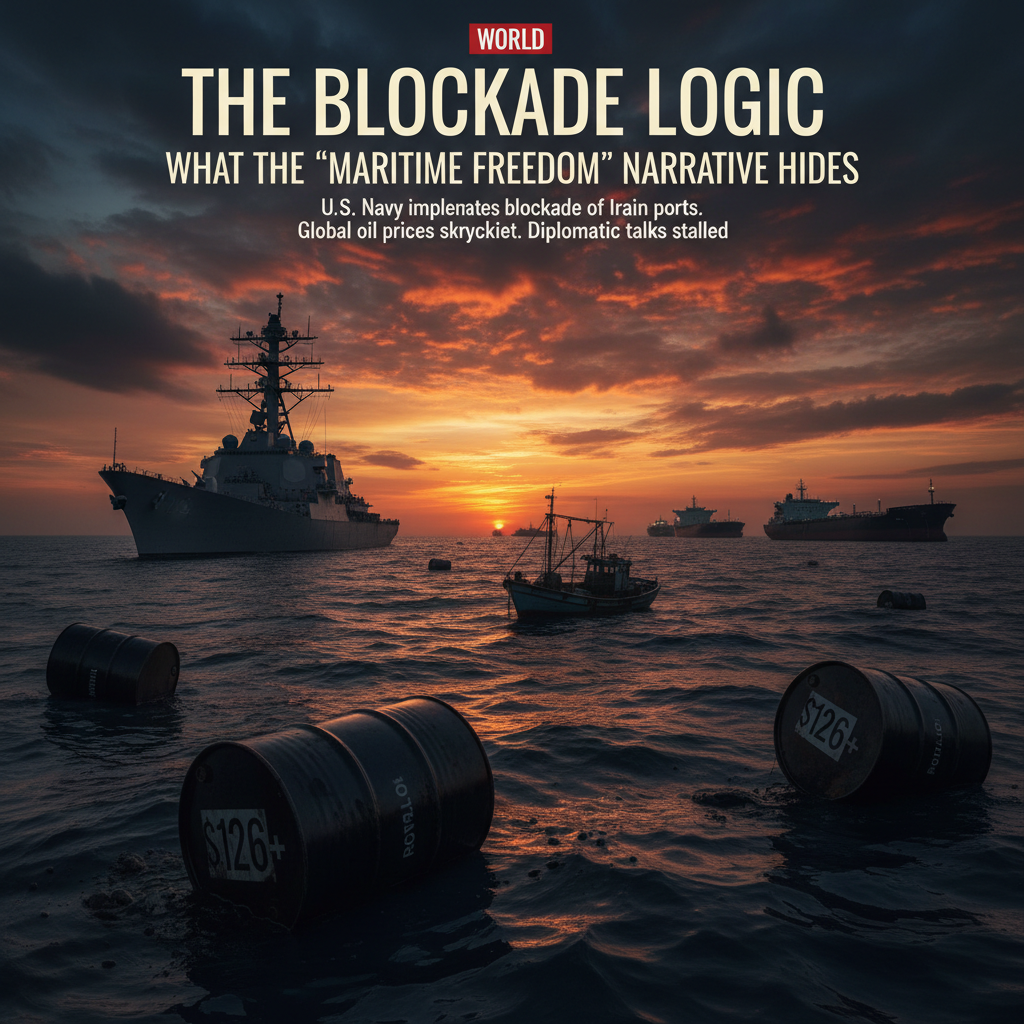
When the Washington Post describes a unilateral naval blockade as a "standoff" or adopts the White House’s branding of a "Maritime Freedom Construct," it is not merely reporting; it is laundering state jargon. The primary failure of mainstream coverage lies in the refusal to call the situation by its legal name: an act of war. A blockade is not a diplomatic maneuver or a "squeeze"—it is a kinetic military operation intended to force an economy into submission through the threat of violence. By echoing the administration's framing, the press transforms an aggressive military escalation into a clinical policy mechanism, shielding the public from the true stakes of the conflict.
What's Missing
The most glaring omission in current coverage is the legal framework governing international waters. Under Article 42 of the United Nations Charter, a blockade is explicitly listed as a military action. By ignoring this, the establishment press avoids asking why the Executive branch has initiated hostilities without a Congressional declaration of war or a new Authorization for Use of Military Force (AUMF). Furthermore, the coverage presents the $126 oil price as an external "market reaction" rather than a direct, predictable consequence of U.S. policy. The administration has effectively placed a "war tax" on the global economy, yet the press frames the resulting financial hardship as a regrettable byproduct rather than a deliberate strategic choice.
FAQ
Q: Does this naval blockade constitute an act of war under international law?
A: Yes. The San Remo Manual on International Law Applicable to Armed Conflicts at Sea, which codifies customary international law, treats a blockade as a method of warfare. Unless the administration can cite an immediate, armed attack by Iran that justifies this as a measure of self-defense, the blockade lacks a basis in international law. By omitting this context, the media treats international treaties as optional suggestions rather than binding commitments that the U.S. is currently bypassing.
Q: What specific legal authority is the President using to bypass Congressional approval?
A: The White House has not cited a specific statute, and mainstream outlets haven't pushed for one. Under the War Powers Resolution of 1973, the President must consult Congress before introducing U.S. Armed Forces into hostilities. A naval blockade, which involves the threat of firing upon merchant vessels, is by definition an introduction of forces into a hostile environment. The silence from the press on this constitutional overreach allows the executive branch to expand its war-making powers without public debate.
Q: How does the administration plan to mitigate the impact of $126/barrel oil on low-income populations?
A: The original reporting focuses on the "success" of the economic pressure on Tehran, but ignores the domestic and global fallout. Oil at this price level is a regressive tax that hits the world’s poorest hardest, driving up the costs of food, heating, and transportation. There is currently no articulated plan to mitigate this impact, yet the press continues to frame the economic data through the lens of geopolitics rather than human cost.
Q: Is there verifiable evidence of nuclear escalation to justify this move?
A: The administration claims the blockade is a response to the nuclear program, but fails to provide updated intelligence showing a deviation from previous enrichment levels. Major outlets have accepted the "nuclear disarmament" justification at face value without demanding a briefing on the specific intelligence that prompted this sudden escalation. This is a classic example of authority deference, where the stated motive of the government is treated as an objective fact.
Access journalism relies on maintaining a cordial relationship with the White House Press Office. When reporters use terms like 'Maritime Freedom Construct' without irony, they are participating in a linguistic shell game designed to mask the aggressive nature of the policy.
This deference to authority results in a sanitized version of events. The use of the word "squeezing" to describe economic warfare is a prime example. To "squeeze" an economy is to degrade civilian infrastructure, restrict the flow of medicine, and destabilize the lives of millions of non-combatants. By using the administration's metaphors, the press helps minimize the severity of total trade suppression, presenting it as a bloodless policy lever rather than a potentially catastrophic intervention.
Ultimately, the situation in the Persian Gulf is not a peer-to-peer "standoff"; it is a profound escalation of executive power. The $126 oil price is the visible cost of a strategy that lacks both a clear legal mandate and a defined exit strategy. Until the press begins questioning the authority behind the blockade rather than just reporting the price of crude, the public will remain in the dark about the true risks of this intervention. What is being sold as a defense of "maritime freedom" is, in reality, the most significant test of unilateral executive war-making in the 21st century.
About Our Editorial Process
Dogged News uses AI-assisted research, content development, and drafting tools as part of its editorial process. Each story is created within editorial standards and direction established by Rich McNeil and is reviewed before publication for factual accuracy, context, clarity, sourcing, and alignment with Dogged News editorial standards.
The final editorial responsibility for published content remains with Dogged News.
Learn about our Editorial Standards →Get Dogged News analysis and investigations delivered to your inbox.
Discussion (0)
0/2000 · Comments are reviewed before publishing.
Have an account? to comment with a verified identity.
No comments yet. Be the first to share your perspective.