

The Beijing Leverage: Why the U.S. Blockade of Iran is a Tool, Not a Distraction
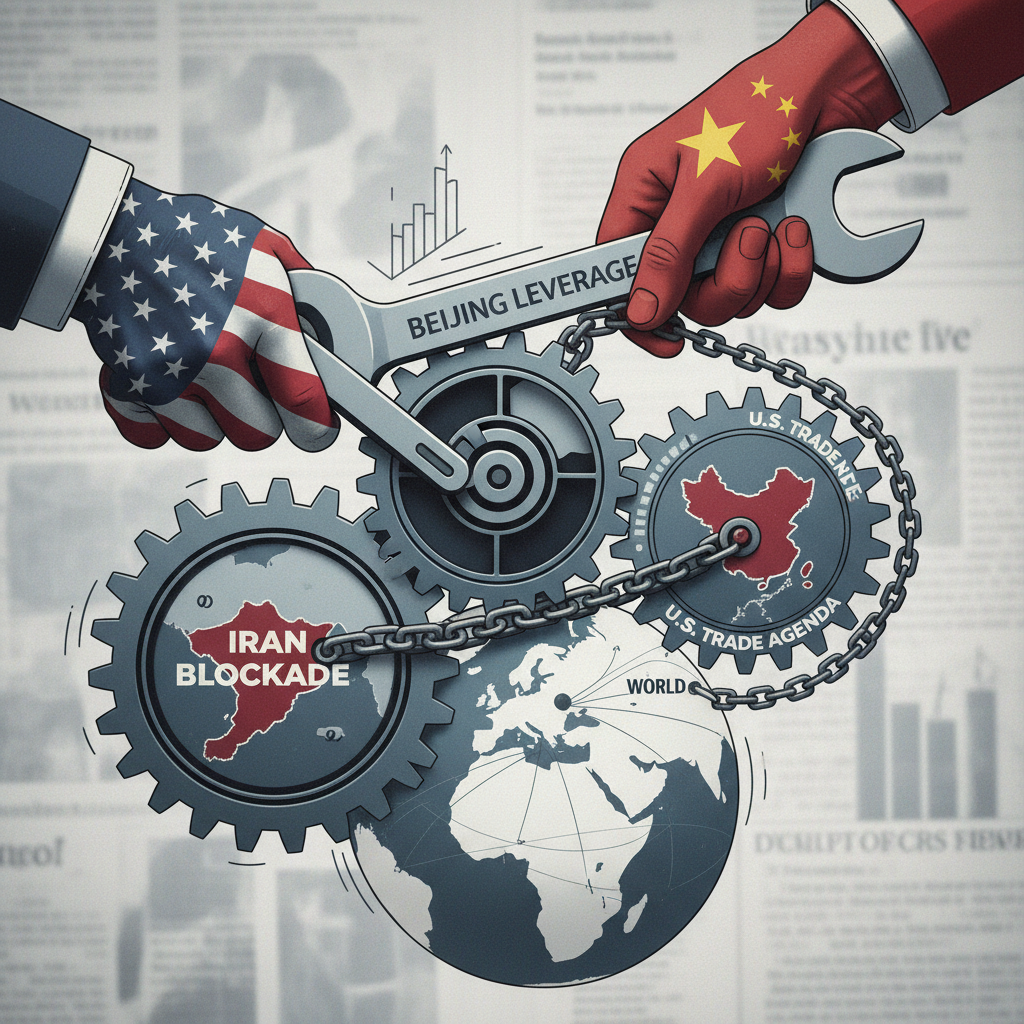
Mainstream reporting on the upcoming summit between U.S. President Donald Trump and Chinese leader Xi Jinping has adopted a peculiar atmospheric tone. Outlets like Time have framed the escalating tensions with Iran as an external phenomenon that has somehow "overshadowed" the planned agenda of trade and Taiwan. This framing is a textbook example of narrative-driven journalism that obscures cause and effect. By treating the Middle East situation as a sudden 'crisis' the administration is trying to 'de-escalate,' the press ignores a fundamental, verifiable fact: the current friction is a direct result of a U.S. naval blockade of Iranian ports.
What We Know
A naval blockade is not a diplomatic maneuver; under international law and historical precedent, it is an act of war. When the press uses the word 'overshadowed,' it suggests that the administration is a passive victim of global instability rather than its primary architect. This deference to authority—often a byproduct of access journalism where reporters rely on high-level background briefings—allows the White House to present itself as a peace-seeker while simultaneously escalating military pressure. The story isn't that Iran is distracting from the China summit; the story is how the U.S. is using the Iran situation as a pivot point for its broader geopolitical strategy.
What's Being Claimed
Under what international legal framework is the U.S. blockade being conducted? The original reporting avoids the word 'blockade' until the very end, and even then, fails to interrogate its legality. Without a UN Security Council mandate or a formal declaration of war, a port blockade exists in a legal gray zone that challenges the 'rules-based order' the U.S. frequently cites. By failing to ask this question, the press grants the administration tacit permission to normalize military aggression as mere 'policy.'
What's Missing
Is the administration offering concessions on Taiwan or trade in exchange for Chinese help with Iran? The 'diplomatic assistance' the U.S. is reportedly seeking from Xi Jinping is not free. China is the primary buyer of Iranian oil. By blockading those ports, the U.S. has effectively seized control of a significant portion of China's energy supply chain. Logic suggests that the 'Iran crisis' is being used as a high-stakes bargaining chip in trade negotiations. If the U.S. can create a problem (oil price surges and supply threats) that only it can solve, it gains immense leverage over Xi's domestic economic stability.
What's Actually Happening
How does the U.S. define 'de-escalation' while maintaining an active blockade? This is the central logical contradiction the press refuses to touch. You cannot 'de-escalate' a situation while your ships are physically preventing a sovereign nation from trading. In this context, 'de-escalation' appears to be a euphemism for 'total capitulation.' By parroting the administration's language, the media helps redefine aggression as a search for peace, making it impossible for the public to understand the actual risk of kinetic conflict.
Conclusion
Stripping away the 'overshadowed' narrative reveals a more calculated reality. The summit in Beijing is not being disrupted by an external war; it is being conducted under the shadow of a deliberate U.S. policy designed to pressure both Tehran and Beijing simultaneously. By controlling the flow of Iranian oil through military force, the U.S. delegation enters the room with Xi Jinping holding a direct lever over the Chinese economy.
The press functions as a megaphone for the state when it adopts the language of 'crisis management' to describe the implementation of military force.
When the media fails to connect the blockade to the oil surge, and the oil surge to the trade negotiations, it fails its readers. This is not a story of a president distracted by a new conflict; it is a story of a president using conflict as a primary tool of economic diplomacy. Understanding this requires looking past the 'peace-making' headlines and focusing on the physical movement of carrier strike groups and the price of a barrel of crude. That is where the real negotiation is happening.
FAQ
Q: Why is the U.S. blockading Iranian ports?
A: The U.S. is blockading Iranian ports as part of a broader geopolitical strategy to exert pressure on both Iran and China, using the disruption of Iran's oil exports as a leverage point in trade negotiations with Beijing.
Q: How does the U.S. justify the blockade under international law?
A: The blockade is conducted without a UN Security Council mandate or a formal declaration of war, placing it in a legal gray zone that contradicts the 'rules-based order' often cited by the U.S.
Q: What are the implications of the blockade for U.S.-China relations?
A: The blockade affects China's energy supply since China is a major buyer of Iranian oil. This gives the U.S. leverage in trade negotiations, potentially impacting other issues like Taiwan.
Q: What role does the media play in shaping the narrative around the U.S. blockade of Iran?
A: The media often frames the situation as a crisis overshadowing the China summit, which can obscure the fact that the U.S. is using this as a strategic tool, thus granting the administration unwanted deference.
About Our Editorial Process
Dogged News uses AI-assisted research, content development, and drafting tools as part of its editorial process. Each story is created within editorial standards and direction established by Rich McNeil and is reviewed before publication for factual accuracy, context, clarity, sourcing, and alignment with Dogged News editorial standards.
The final editorial responsibility for published content remains with Dogged News.
Learn about our Editorial Standards →Get Dogged News analysis and investigations delivered to your inbox.
Discussion (0)
0/2000 · Comments are reviewed before publishing.
Have an account? to comment with a verified identity.
No comments yet. Be the first to share your perspective.