

Sovereignty by Map: The De Facto Annexation of Two-Thirds of Gaza
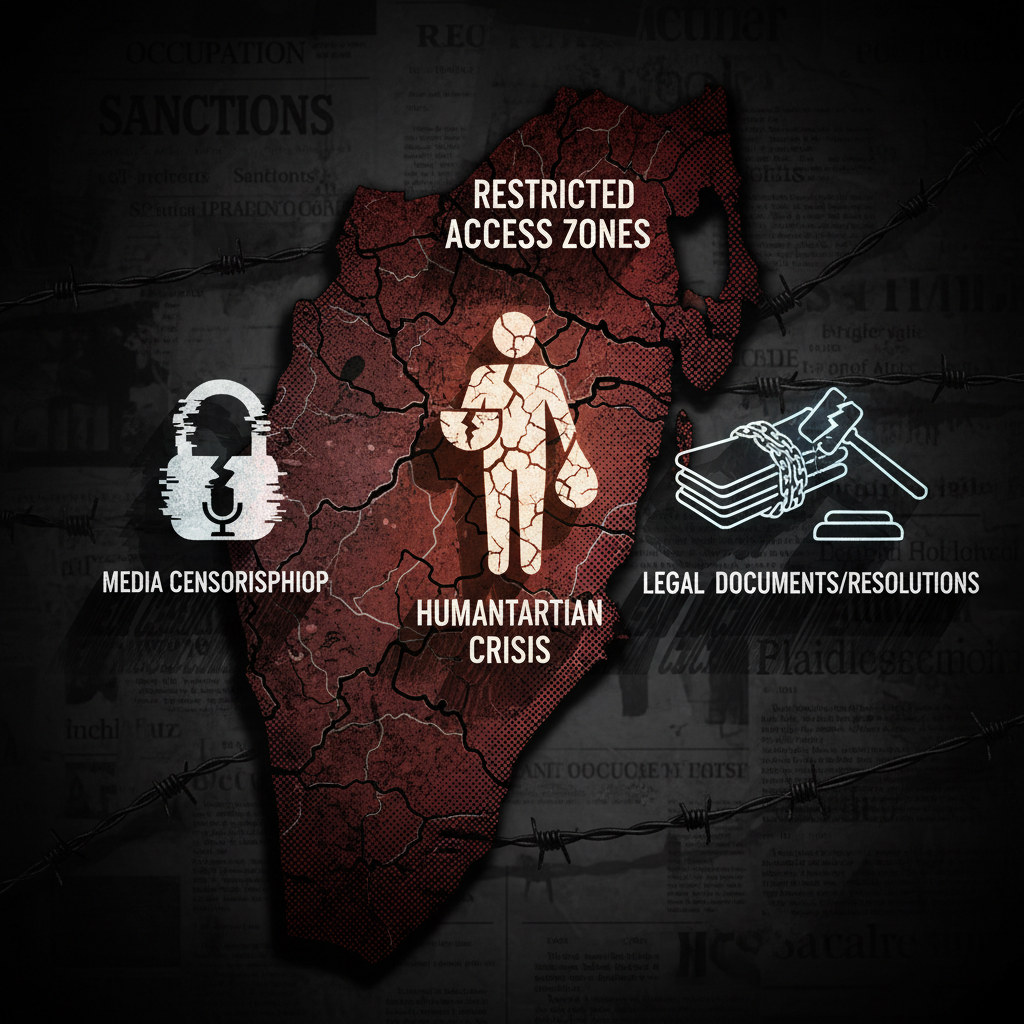
In the standard reporting of the conflict in Gaza, a critical shift has occurred: the transformation of war reporting into administrative stenography. Recent coverage of the Israeli Defense Forces (IDF) updated military maps suggests that Israel is 'quietly' expanding its restricted zones. This framing treats a massive territorial reorganization as a procedural update rather than a fundamental shift in the status of the land. By adopting the military’s own mapping as the objective baseline, the press has transitioned from questioning the legitimacy of land seizure to merely recording its coordinates.
The central failure of mainstream reporting is the acceptance of the 'restricted zone' as a legitimate administrative category rather than a mechanism of de facto annexation.
By using the term 'restricted zones,' journalists are sanitizing a policy that effectively removes two-thirds of the Gaza Strip from the reach of its inhabitants. This isn't a 'quiet' expansion; it is a loud and systemic redrawing of borders by an occupying power that has no sovereign claim to the land it is rezoning. The reliance on military-provided data, without the presence of independent verification on the ground, represents a profound deference to authority that masks the human and legal stakes of these territorial shifts.
What We Know
Mainstream accounts have largely failed to connect the expansion of these zones with the simultaneous ban on foreign media access. The press treats these as two separate issues: a military map update and a professional grievance about media access. In reality, they are two sides of the same coin. The 'quietness' of the territorial expansion is only possible because of the noise-canceling effect of the media ban. By preventing independent journalists from entering the territory, the IDF ensures that the map is the only reality the world sees.
Furthermore, the reporting fails to challenge the euphemism of the 'coastal area' where civilians are being funneled. This is not a safe haven; it is a resource-starved sliver of land that cannot sustain the biological needs of the displaced population. To describe the confinement of hundreds of thousands of people into a shrinking coastal strip as a 'military evolution' is to ignore the logistical certainty of a humanitarian collapse. The press has focused on the where of the displacement, but has largely ignored the why of the administrative terminology used to justify it.
FAQ
Q: What is the legal basis for an occupying power to unilaterally rezone territory it does not own?
A: Under International Humanitarian Law, specifically the Fourth Geneva Convention, an occupying power is prohibited from altering the status of the territory or its inhabitants, except for the most narrow and temporary security necessities. Declaring 66% of a territory 'restricted' for an indefinite period moves beyond security and into the realm of administrative control. The press has failed to ask whether these zones constitute a violation of the prohibition against collective punishment or the illegal annexation of territory through military fact-finding.
Q: Are these 'restricted zones' intended to be permanent?
A: The history of military 'buffer zones' in the region suggests they rarely contract. By not asking about the planned duration of these designations, the press allows the IDF to establish a 'new normal' without a timeline for restoration. If these zones remain restricted after active hostilities cease, they become a de facto annexation—a permanent reduction of Palestinian territory through the slow-motion application of military mapping.
Q: What is the calculated mortality rate of the remaining 'safe' zone?
A: Logistical experts and NGOs have warned that the population density in the remaining 33% of Gaza is unsustainable. The original reporting fails to ask for the data behind the IDF’s decision: did the military conduct a feasibility study on whether the coastal area can support the caloric, medical, and sanitary needs of the displaced? Without these answers, the 'restricted' zones are not just military lines; they are boundaries of a human catastrophe.
Conclusion
When we strip away the sanitized military terminology, the facts are clear. Israel is using administrative mapping to effectively seize control of the majority of the Gaza Strip, while simultaneously maintaining a media blackout that prevents the world from seeing the physical reality of that seizure. This is not 'quiet' expansion; it is an active redrawing of the map that bypasses international oversight and legal constraints. The media’s role is not to simply mirror the maps provided by military authorities, but to question the legal, human, and political legitimacy of those lines. When the map becomes the primary source of truth, the actual ground is lost—and with it, the possibility of accountability.
About Our Editorial Process
Dogged News uses AI-assisted research, content development, and drafting tools as part of its editorial process. Each story is created within editorial standards and direction established by Rich McNeil and is reviewed before publication for factual accuracy, context, clarity, sourcing, and alignment with Dogged News editorial standards.
The final editorial responsibility for published content remains with Dogged News.
Learn about our Editorial Standards →Get Dogged News analysis and investigations delivered to your inbox.
Discussion (0)
0/2000 · Comments are reviewed before publishing.
Have an account? to comment with a verified identity.
No comments yet. Be the first to share your perspective.