

Escorts or Logistics? The Strategic Reality Behind 'Project Freedom'
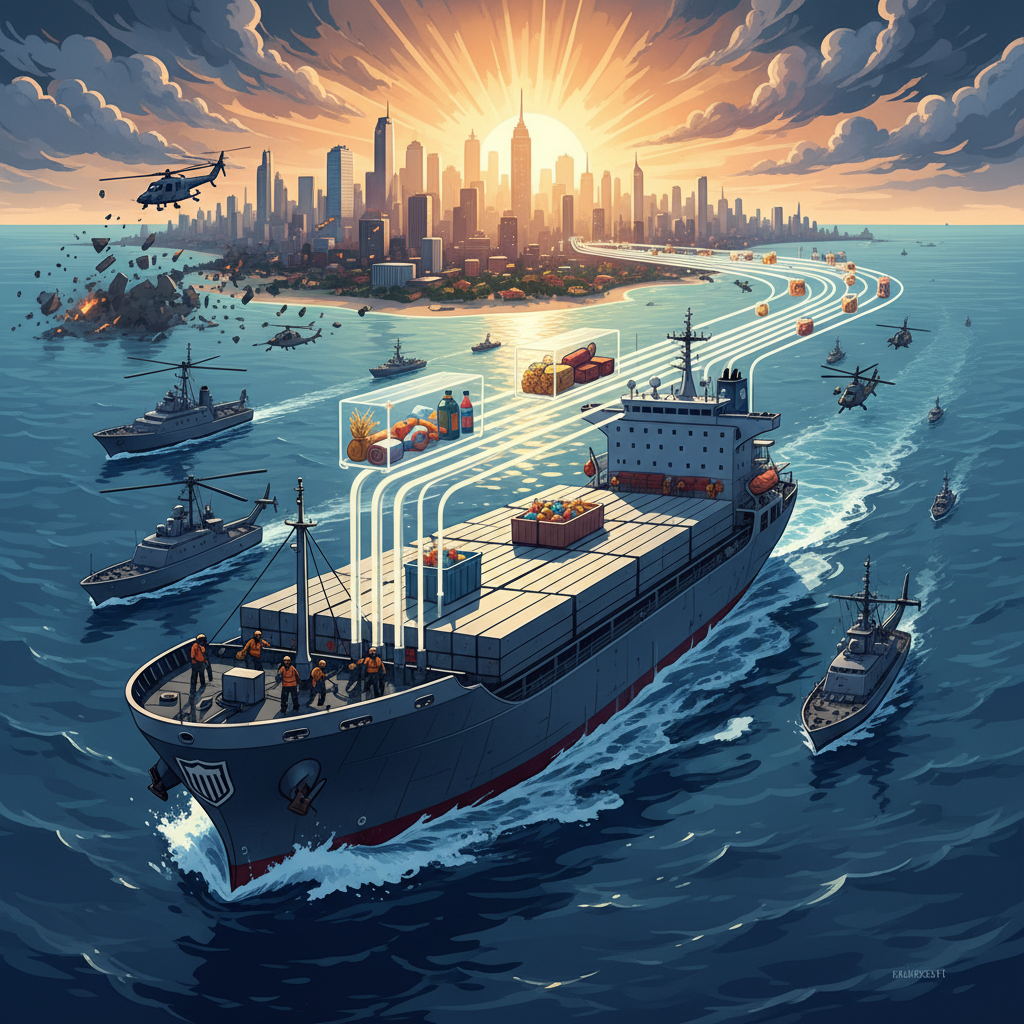
Mainstream reporting on the launch of 'Project Freedom' has largely functioned as a mirror for Pentagon press releases. While the establishment media has focused on the administration's humanitarian framing, it has failed to investigate the primary geopolitical reality: the United States is unilaterally redefining the security architecture of the world's most critical energy chokepoint. By adopting the government's branding without skepticism, initial coverage obscured the fact that this 'coordination cell' operates without the public acknowledgment or cooperation of the other primary stakeholder in the region: Iran.
What's Being Claimed
Furthermore, the press has treated the declaration of a 'ceasefire' as a settled fact. In reality, a ceasefire requires two parties. Without a formal, bilateral agreement verified by international monitors, the Strait of Hormuz remains a contested zone. Characterizing the area as 'no longer a zone of active hostilities' shifts the burden of risk onto commercial shipping interests, based entirely on a U.S. military assessment that has not been independently corroborated.
What's Missing
The term 'guidance' is a tactical euphemism. If U.S. Central Command is directing the movement of ships, it is implicitly offering protection. However, the administration has not clarified whether U.S. forces will open fire if these commercial vessels are harassed or boarded. By framing this as a logistics exercise rather than a naval escort, the government avoids the political friction of a war-footing declaration while maintaining the hardware on-site to escalate at will.
What are the specific rules of engagement if the coordination cell encounters Iranian naval vessels?
The number 850 is a significant statistical claim that provides the scale for the 'humanitarian' narrative. However, there has been no independent audit of these vessels. It remains unclear how many are high-tonnage tankers, what percentage are U.S.-flagged, and how many are actually 'trapped' versus simply waiting for lower insurance premiums. If the bulk of these ships are non-U.S. vessels, the operation effectively uses American taxpayer resources to subsidize the risk management of foreign corporations and global commodity markets.
Who provided the figure of 850 ships and what is the breakdown of their nationalities?
Commercial maritime insurance typically becomes void in active war zones. By claiming the zone is safe, the U.S. is encouraging ships to enter. Yet, there is no evidence the U.S. government has agreed to indemnify these owners if 'guidance' leads to a strike or a grounding. This is a crucial distinction: the U.S. is providing the directions but likely leaving the private sector to carry the financial risk of those directions.
Is the U.S. assuming liability for these commercial vessels?
What's Actually Happening
The early coverage of this initiative is a textbook example of authority deference. When journalists use terms like 'Project Freedom' without quotation marks or qualifying language, they stop being reporters and start being relay stations for state communications. This 'stenography' allows the government to set the moral high ground—labeling a strategic naval intervention as a 'humanitarian initiative'—before the actual mechanics of the operation can be scrutinized. Access to briefings is often predicated on this kind of uncritical echoing, creating an incentive structure where the most compliant outlets get the first 'scoop.'
Conclusion
Beyond the branding, 'Project Freedom' is an assertion of American maritime hegemony. It is less about humanitarian relief for stranded sailors and more about demonstrating that the U.S. Navy remains the sole guarantor of global trade flow, regardless of regional tensions. By bypassing international maritime bodies and creating its own 'coordination cell,' Washington is signaling that it will dictate the terms of passage in the Strait of Hormuz unilaterally. The story isn't just that ships are moving; it's that the U.S. is now the one holding the map, the megaphone, and the trigger.
FAQ
Q: What is the primary goal of 'Project Freedom'?
A: The primary goal of 'Project Freedom' is to redefine the security architecture of the Strait of Hormuz and assert American maritime hegemony by establishing a unilateral coordination cell to guide commercial vessels through the region.
Q: How has the media covered 'Project Freedom'?
A: The media has largely echoed Pentagon press releases, branding the project as a humanitarian initiative and failing to critically analyze its strategic and geopolitical implications, such as the unilateral nature of the operation and the lack of Iranian cooperation.
Q: Does 'Project Freedom' include military protection for commercial vessels?
A: While the coordination cell is said to guide ships, the U.S. administration has not clearly stated whether military forces will engage or protect these vessels if they are threatened or boarded.
Q: Is the U.S. liable for commercial vessels navigating the Strait of Hormuz under this program?
A: The U.S. has not agreed to indemnify commercial vessel owners, leaving the financial risk on the private sector despite directing their movement through the contested area.
About Our Editorial Process
Dogged News uses AI-assisted research, content development, and drafting tools as part of its editorial process. Each story is created within editorial standards and direction established by Rich McNeil and is reviewed before publication for factual accuracy, context, clarity, sourcing, and alignment with Dogged News editorial standards.
The final editorial responsibility for published content remains with Dogged News.
Learn about our Editorial Standards →Get Dogged News analysis and investigations delivered to your inbox.
Discussion (0)
0/2000 · Comments are reviewed before publishing.
Have an account? to comment with a verified identity.
No comments yet. Be the first to share your perspective.