

Diplomacy by Press Release: Decoding the U.S.-Iran "Peace Proposal"
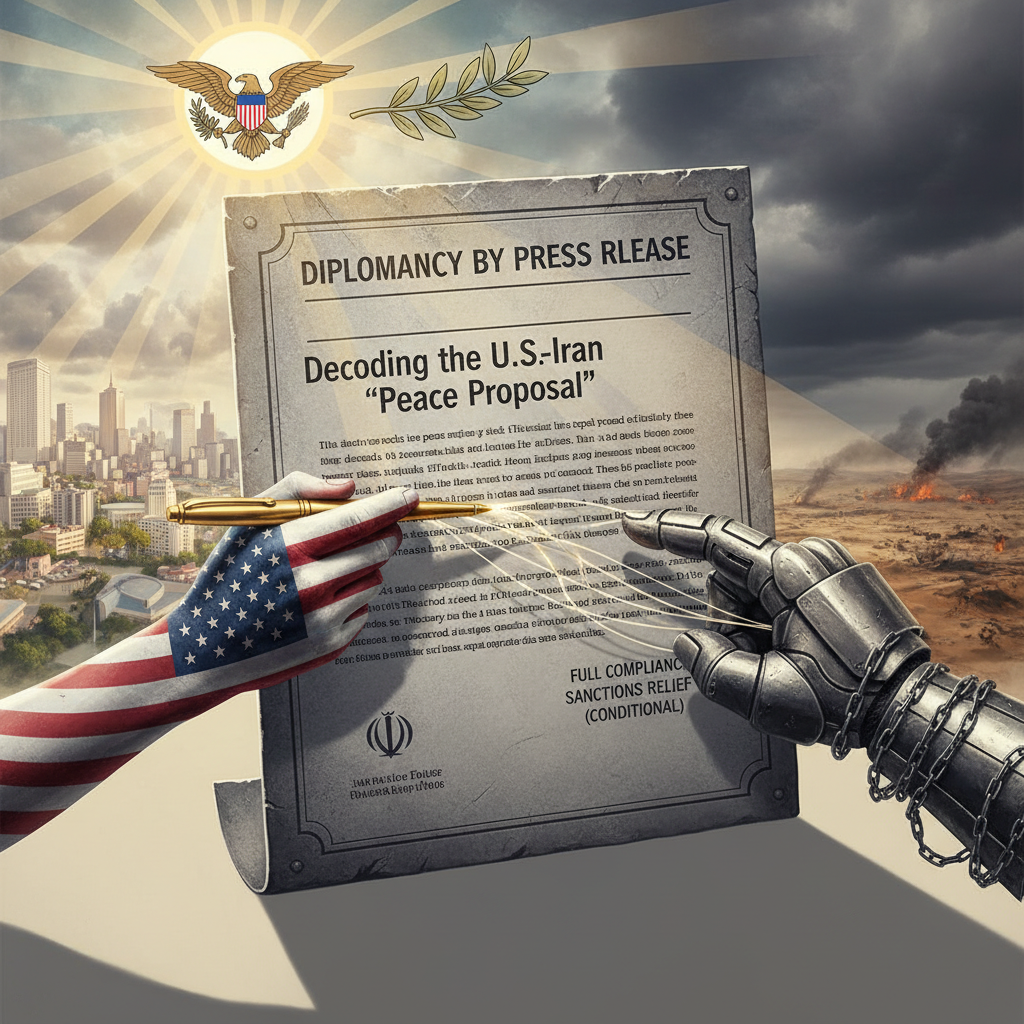
In the wake of a two-month military escalation, mainstream reporting has largely defaulted to the administration’s own framing: that a "peace proposal" is on the table and the prospect of a "swift end" depends entirely on Iranian compliance. However, by leading with the President’s personal optimism, major outlets have engaged in a form of access journalism that prioritizes the administration’s branding over a structural analysis of the deal itself.
What's Being Claimed
What is missing from the initial coverage is the distinction between a collaborative peace treaty and a unilateral list of conditions. The term "peace proposal" suggests a bilateral negotiation that has reached a consensus. In reality, the memorandum presented to Tehran functions more as an ultimatum, conditioning the cessation of active military hostilities on the total reversal of Iran’s nuclear policy and its primary maritime leverage. By reporting the White House’s confidence as a neutral fact, the press obscures the underlying mechanics of the conflict: the U.S. is using the leverage of existing sanctions and recent military pressure to demand specific concessions, while offering a return to a status quo that it previously dismantled.
What's Missing
The primary hurdle in any U.S.-Iran negotiation is the issue of credibility. Following the 2018 withdrawal from the Joint Comprehensive Plan of Action (JCPOA), Iranian leadership views U.S. promises of "sanctions relief" with extreme skepticism. The current memorandum, as reported, does not specify whether this relief is a temporary suspension via executive waiver or a permanent legislative change. Without a verification mechanism that protects the Iranian economy from a future administration’s policy reversal, the offer of relief is structurally hollow. History suggests that Tehran will not trade its nuclear leverage for a promise that can be revoked by a single signature in Washington.
The memorandum demands a "moratorium on nuclear enrichment," a phrase that sounds simple but is technically complex. Iran has long maintained that its enrichment at lower percentages is for medical research and energy production. If the U.S. proposal demands a total halt to all enrichment—including civilian applications—it is effectively asking for a surrender of Iranian domestic infrastructure rather than a military de-escalation. The original reporting failed to interrogate whether the U.S. is willing to distinguish between power generation and weapons-grade material, a distinction that is often the difference between a successful deal and a diplomatic stalemate.
Optimism is a political sentiment, not a strategic data point. Behind the scenes, the two-month conflict has likely incurred significant costs for both sides. For the U.S., the deployment of carrier strike groups and the risk of spikes in global oil prices create political pressure at home. For Iran, the economic weight of tightened sanctions and the threat of direct military strikes on infrastructure create an existential crisis. The "swift end" predicted by the President is less likely a result of sudden diplomatic goodwill and more likely a reflection of both nations reaching the limits of their current escalatory capacity.
What's Actually Happening
The reporting on this memorandum serves as a textbook example of authority deference. By adopting the term "peace proposal," journalists act as the PR wing of the State Department. This terminology frames the U.S. as a benevolent actor seeking an end to violence, while framing Iran’s review process as the only obstacle to global stability. A fact-first approach would instead label the document as a "conditional memorandum of terms."
"When the media adopts the vocabulary of the state, it ceases to report on the state and begins to advocate for it."
This lack of skepticism is particularly dangerous in high-stakes foreign policy. By failing to consult Iranian sources or independent diplomatic experts who could highlight the historical non-starters in the document, the press prepares the public for a narrative of "Iranian aggression" should the deal fail. If the proposal is designed to be rejected—a common tactic to justify further escalation—the press has already done the heavy lifting by characterizing it as a generous offer of peace.
Conclusion
Stripped of its "peace" branding, the situation is a high-stakes standoff where the U.S. is attempting to trade a cessation of its own pressure campaign for permanent Iranian strategic concessions. The "optimism" expressed by the administration serves a domestic political purpose, signaling to voters that the conflict is under control. However, the lack of ironclad guarantees on sanctions and the broad demands on nuclear enrichment suggest that a "swift end" is a strategic projection rather than a likely reality. True peace requires a parity of incentives; what we are seeing is an attempt to achieve victory through a memo.
FAQ
Q: What is the main criticism of the U.S. media's reporting on the peace proposal?
A: The main criticism is that the U.S. media has adopted the administration's language, calling it a 'peace proposal,' which obscures the deal's nature as a unilateral list of demands rather than a collaborative treaty.
Q: Why is Iran skeptical about the U.S. promise of sanctions relief?
A: Iran is skeptical because, since the U.S. withdrew from the JCPOA in 2018, it doubts the permanence of such relief, fearing it could be revoked by future U.S. administrations without a verification mechanism.
Q: What does the term 'moratorium on nuclear enrichment' mean in this context?
A: In this context, it means a demand for Iran to halt all nuclear enrichment activities, including those for medical and energy purposes, which could be seen as a surrender of its domestic infrastructure.
Q: How does the media's use of terminology affect public perception of the U.S.-Iran negotiations?
A: By using terms like 'peace proposal,' the media frames the U.S. as a benevolent actor and Iran as the obstacle, skewing public perception towards viewing the U.S. position as inherently peaceful.
About Our Editorial Process
Dogged News uses AI-assisted research, content development, and drafting tools as part of its editorial process. Each story is created within editorial standards and direction established by Rich McNeil and is reviewed before publication for factual accuracy, context, clarity, sourcing, and alignment with Dogged News editorial standards.
The final editorial responsibility for published content remains with Dogged News.
Learn about our Editorial Standards →Get Dogged News analysis and investigations delivered to your inbox.
Discussion (0)
0/2000 · Comments are reviewed before publishing.
Have an account? to comment with a verified identity.
No comments yet. Be the first to share your perspective.