

The $1 Billion Ballroom: Security Necessity or Legislative Hostage-Taking?
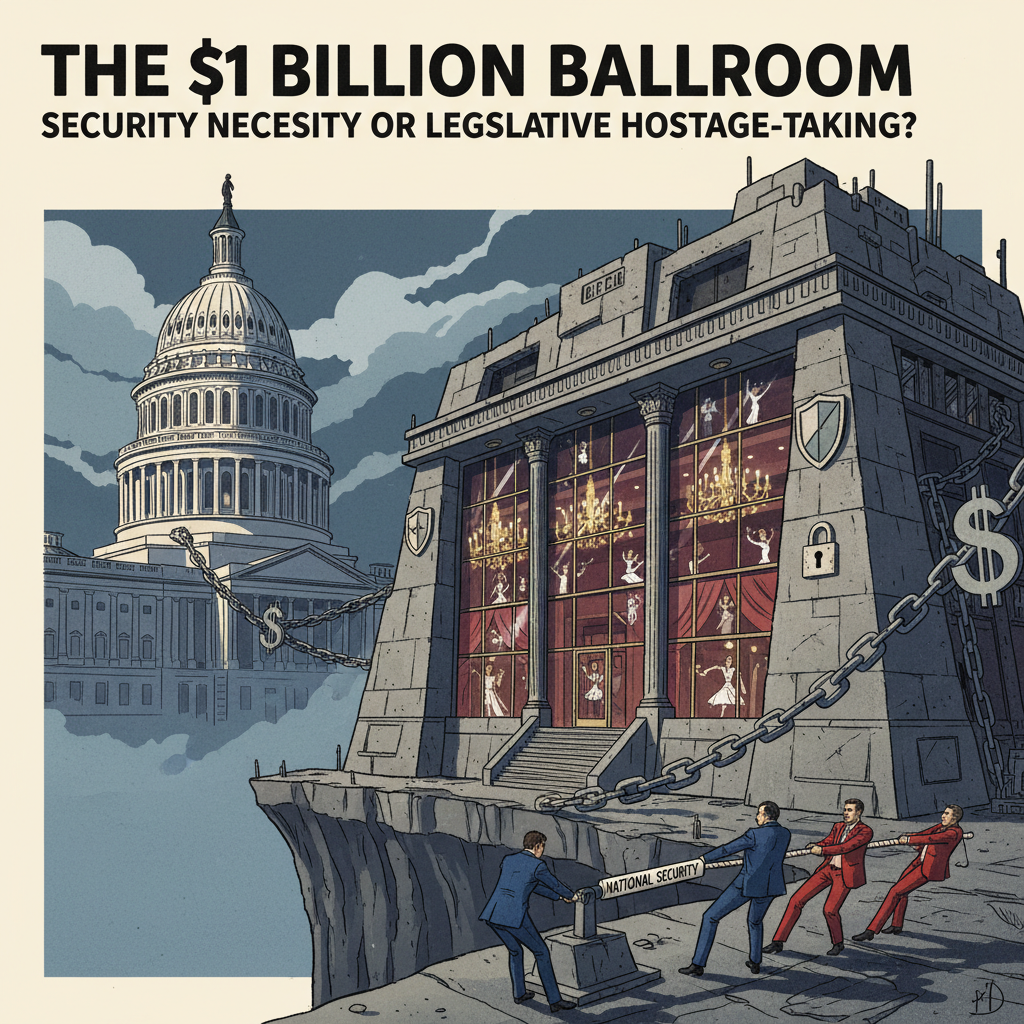
Mainstream reporting on the proposed $1 billion security budget for a new White House ballroom has largely followed a predictable script: framing the issue as a standard partisan 'vow to fight' between Democrats and Republicans. By focusing on the political theater of the disagreement, the press has largely deferred to the administration’s security narrative, failing to scrutinize the underlying logic or the fiscal scale of the request. This is a classic example of access journalism, where reporters prioritize maintaining a relationship with official sources over questioning the validity of the technical claims those sources provide.
What We Know
The media has uncritically echoed terms like 'heavy fortification' and 'modern threats' without consulting independent structural engineers or security analysts to determine if a ballroom—a space primarily used for social and ceremonial functions—is a logical focus for drone-strike mitigation. Furthermore, the reporting has normalized the 'bundling' of this construction project with immigration enforcement funds, treating a blatant legislative 'poison pill' strategy as a routine procedural maneuver rather than an act of institutional coercion.
FAQ
Q: What is the line-item breakdown for a $1 billion single-room project?
A: To put a $1 billion price tag in perspective, the entire annual operating budget for the Executive Residence is approximately $15 million. Even high-security federal facilities, such as the 'supermax' ADX Florence, cost significantly less to construct from the ground up than this single proposed ballroom renovation. By failing to demand a line-item breakdown, the press allows the $1 billion figure to stand as a legitimate baseline. Without transparency on which defense contractors or construction firms are slated for the work, the public cannot identify the economic incentives driving this proposal.
Q: How does a fortified ballroom address the specific threat of drone strikes?
A: The White House justification links the ballroom to a recent assassination attempt involving a drone. However, security logic suggests that protecting a high-profile target from aerial threats requires comprehensive electronic warfare (EW) capabilities, signal jamming, and integrated air defense systems across the entire 18-acre complex—not the structural hardening of a single social hall. If the ballroom is the only 'fortified' space, it creates a 'bunker mentality' that does nothing to secure the President or staff in the dozens of other vulnerable areas of the White House. The press has failed to ask why this specific room is the priority over broader, less 'extravagant' technological solutions.
Q: Is this a legitimate security need or a fiscal hostage situation?
A: The decision to bundle this funding with essential immigration enforcement budgets is a strategic choice designed to bypass debate. By linking a controversial, high-cost project to a must-pass security priority, the administration forces a binary choice: fund the ballroom or be accused of 'defunding' the border. This tactic is a hallmark of legislative maneuvering that avoids accountability. The media's failure to call out this coercion by name allows the administration to frame Democratic opposition as 'obstructive' rather than a demand for fiscal oversight.
"When 'national security' is invoked, the normal rules of fiscal auditing are often suspended. The role of the press is to ensure that the label 'security' isn't being used as a shield for discretionary spending that would otherwise fail a cost-benefit analysis."
Conclusion
This story is not about a ballroom; it is about the continued erosion of fiscal oversight when 'security' is used as a justification. When a $1 billion request is treated as a routine partisan dispute, the public loses the ability to distinguish between essential protection and performative architecture. The lack of scrutiny on the actual security efficacy of the project, combined with the uncritical parroting of administration buzzwords, demonstrates a media environment that is more interested in the 'who is winning' narrative than the 'what is being spent' reality.
Ultimately, the bundling of these funds suggests that the proposal may not be able to stand on its own merits. If the security need were as dire as the White House maintains, it would not need to be hidden inside a larger, unrelated spending bill. True security is built on transparency and logical resource allocation, not on billion-dollar social halls shielded from public audit.
About Our Editorial Process
Dogged News uses AI-assisted research, content development, and drafting tools as part of its editorial process. Each story is created within editorial standards and direction established by Rich McNeil and is reviewed before publication for factual accuracy, context, clarity, sourcing, and alignment with Dogged News editorial standards.
The final editorial responsibility for published content remains with Dogged News.
Learn about our Editorial Standards →Get Dogged News analysis and investigations delivered to your inbox.
Discussion (0)
0/2000 · Comments are reviewed before publishing.
Have an account? to comment with a verified identity.
No comments yet. Be the first to share your perspective.