

Permanent Probation: The Legal Reality Behind the DOJ’s Citizenship Crackdown
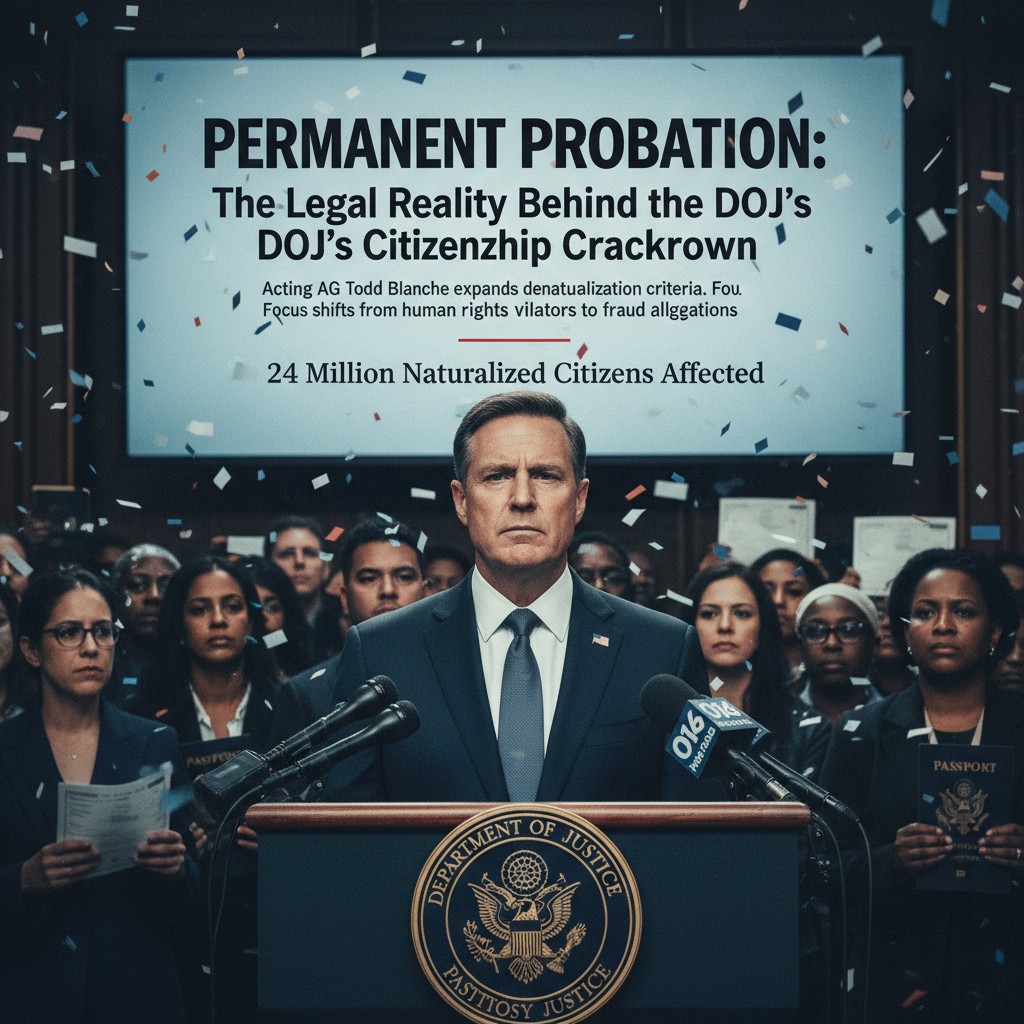
In the wake of Acting Attorney General Todd Blanche’s announcement regarding an expanded initiative to revoke U.S. citizenship, mainstream reporting has largely functioned as a PR extension for the Department of Justice. By using celebratory verbs like “touted” and “expanded,” outlets like CBS News have framed a significant shift in legal policy as a mere administrative upgrade. This is access journalism in its purest form: prioritizing a government official’s narrative over a rigorous examination of the legal and constitutional implications.
What We Know
What the press missed—or chose to ignore—is the transition from targeting war criminals and human rights violators to a nebulous, catch-all category of “fraud.” By failing to define what constitutes fraud in this context, the coverage grants the executive branch the power to set its own goalposts. Furthermore, the reporting treats naturalized citizenship as a stable status, failing to mention that this policy effectively establishes a two-tiered system where 24 million Americans now exist in a state of permanent legal precarity that birthright citizens do not face.
“The initiative moves beyond human rights cases to include those accused of any form of fraud.” — A statement accepted by the press without inquiry into the definition of ‘materiality.’
FAQ
Q: How does this policy reconcile with the Supreme Court’s ruling in Maslenjak v. United States?
A: In 2017, the Supreme Court ruled in Maslenjak v. United States that the government cannot revoke citizenship over trivial false statements. To denaturalize someone, the government must prove that the false statement actually played a role in the acquisition of citizenship. The current DOJ announcement implies a return to a pre-2017 mindset where any discrepancy, no matter how minor or irrelevant to the applicant’s eligibility, could be used as a lever for removal. The press failed to ask Blanche how the DOJ intends to bypass or reinterpret this binding precedent.
Q: Is there a statute of limitations on these “fraud” investigations?
A: Unlike most civil and criminal matters, denaturalization proceedings often lack a statute of limitations. This means a 70-year-old citizen who has lived in the U.S. for four decades could theoretically face citizenship revocation for a clerical error made in the 1980s. By ignoring the temporal scope of this initiative, the media obscures the fact that this is not just about current “bad actors,” but about the potential retrospective auditing of millions of settled lives.
Q: What safeguards exist to prevent the weaponization of denaturalization?
A: When the criteria for stripping citizenship shift from specific, heinous acts (like participation in genocide) to broad “fraud,” the process becomes susceptible to political influence. Without a clear legal threshold, “fraud” can be interpreted selectively. Neither the DOJ nor the reporting agencies have addressed how the department will ensure that these powers aren’t used to target political dissidents, specific ethnic groups, or individuals who have otherwise drawn the ire of the administration.
Q: What is the scale of the bureaucratic infrastructure required for this?
A: Investigating 24 million naturalized citizens is a gargantuan task that requires significant funding, staffing, and data-sharing between the DHS and DOJ. The press failed to ask for a budget breakdown or a projected timeline. Without these details, the “expansion” is either a logistical impossibility or a sign of an incoming, massive increase in the surveillance apparatus directed at foreign-born Americans.
Why It Matters
Stripped of the administrative jargon, this story is not about “protecting the integrity” of the immigration system; it is about the fundamental redefinition of what it means to be an American. For the naturalized population, citizenship is being transitioned from a final destination into a revocable license. By allowing the DOJ to frame this as a simple anti-fraud measure, the media facilitates the normalization of a two-tiered society.
Logic dictates that if the government can revoke citizenship for “any form of fraud” without a strict materiality standard or a statute of limitations, then no naturalized citizen is truly secure. The policy creates a permanent class of “probationary citizens” whose rights are contingent upon the continued favor of the state. This is a profound shift in the American social contract, and it deserves more than the stenography it has received thus far.
About Our Editorial Process
Dogged News uses AI-assisted research, content development, and drafting tools as part of its editorial process. Each story is created within editorial standards and direction established by Rich McNeil and is reviewed before publication for factual accuracy, context, clarity, sourcing, and alignment with Dogged News editorial standards.
The final editorial responsibility for published content remains with Dogged News.
Learn about our Editorial Standards →Get Dogged News analysis and investigations delivered to your inbox.
Discussion (0)
0/2000 · Comments are reviewed before publishing.
Have an account? to comment with a verified identity.
No comments yet. Be the first to share your perspective.