

Beyond the Ballroom: The DOJ’s $400 Million Rhetorical Shield
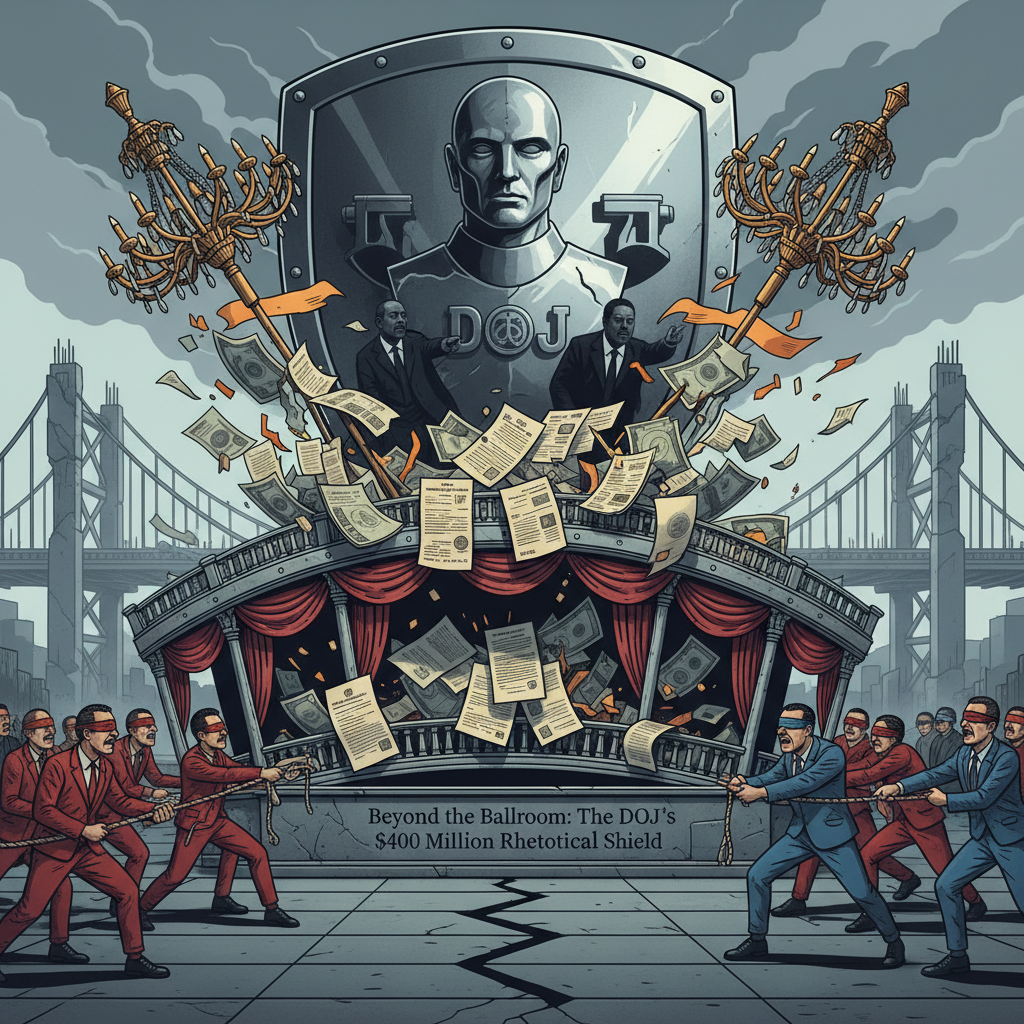
In the recent reporting on the Department of Justice’s push for a $400 million White House ballroom, the mainstream press has transitioned from investigative reporting to administrative stenography. By leading with the government’s own framing—that this project is a 'national security imperative'—major outlets have effectively laundered a massive expenditure through the lens of trauma and threat, rather than fiscal or architectural logic.
What We Know
What was omitted is the fundamental disconnect between a violent event (a shooting at a dinner) and the proposed solution (a luxury ballroom). The press largely ignored the unprecedented use of political slang, specifically 'Trump Derangement Syndrome,' within a formal legal motion. By failing to scrutinize the DOJ’s adoption of online pejoratives, journalists allowed the agency to pathologize legitimate fiscal dissent. Furthermore, the coverage systematically bypassed any mention of the private interests and contractors who stand to gain from a fast-tracked, non-competitive $400 million contract, opting instead to focus on the partisan theater provided by the DOJ’s legal team.
What's Actually Happening
The DOJ cites the Correspondents' Dinner shooting as the primary catalyst. However, that event took place at a private hotel, not the White House grounds. The argument that a $400 million room inside the most fortified residence on earth provides a security 'fix' for off-site events is logically incoherent. In reality, the project appears to be an infrastructure expansion using a security crisis as a procedural bypass for standard procurement oversight.
What's Missing
Without demanding a breakdown of these costs, the press is ignoring potential 'gold-plating'—the practice of inflating government contracts to benefit specific stakeholders or to hide unrelated expenditures under a single, vague header.
What's Being Claimed
The inclusion of 'Trump Derangement Syndrome' in a legal filing is not merely a colorful quote; it is a tactical weaponization of language. It serves to frame the legal opposition not as citizens concerned with constitutional spending limits, but as mentally unstable partisans. By echoing this phrase in headlines without distance or criticism, the press engages in 'access journalism'—prioritizing the maintenance of their relationship with DOJ sources over the objective analysis of the government’s rhetorical strategies.
Why It Matters
When a project is designated a 'national security imperative,' standard competitive bidding processes are often waived. The press has failed to identify which construction conglomerates or security consultants are poised to receive this $400 million windfall. Following the money is the first rule of accountability, yet in this instance, the media followed the narrative instead.
Conclusion
This story is not about a ballroom; it is about the erosion of the 'power of the purse.' When a government agency can successfully use a tragedy to justify a luxury expense, and then use partisan insults to silence the resulting legal challenges, the mechanism of checks and balances has failed.
The press acts as a vital component of those checks, but only when it remains skeptical of official justifications. In this case, by adopting the DOJ's language and ignoring the absence of a logical link between the shooting and the construction, the media has provided the executive branch with a roadmap for bypassing oversight: declare a security emergency, inflate the cost, and label all critics as irrational.
In the final analysis, the $400 million ballroom is a monument to how easily 'national security' can be invoked to mask administrative expansion and stifle the basic democratic requirement of fiscal accountability.
FAQ
Q: Why is the DOJ pushing for a $400 million ballroom?
A: The DOJ claims the ballroom is a national security imperative, citing a shooting at a Correspondents' Dinner as the primary catalyst. However, the logic behind this expenditure is questioned since the incident occurred at a private hotel, not the White House.
Q: What is the significance of using 'Trump Derangement Syndrome' in the DOJ's legal motion?
A: Using 'Trump Derangement Syndrome' as a formal legal term allows the DOJ to frame legal dissent as irrational partisanship, influencing public perception and minimizing fiscal accountability concerns by discrediting critics.
Q: How has the media responded to the DOJ's ballroom project?
A: The media has largely adopted the government's narrative, emphasizing the claimed security justification while neglecting a deeper investigation into fiscal concerns or potential conflict of interest in the awarding of contracts.
Q: What are potential concerns with bypassing standard procurement oversight in this project?
A: By declaring it a national security imperative, the DOJ can waive competitive bidding, which raises concerns about gold-plating and inflating costs to benefit specific stakeholders without public or competitive scrutiny.
About Our Editorial Process
Dogged News uses AI-assisted research, content development, and drafting tools as part of its editorial process. Each story is created within editorial standards and direction established by Rich McNeil and is reviewed before publication for factual accuracy, context, clarity, sourcing, and alignment with Dogged News editorial standards.
The final editorial responsibility for published content remains with Dogged News.
Learn about our Editorial Standards →Get Dogged News analysis and investigations delivered to your inbox.
Discussion (0)
0/2000 · Comments are reviewed before publishing.
Have an account? to comment with a verified identity.
No comments yet. Be the first to share your perspective.