

Beyond Judicial Skepticism: The Statutory Reality of Interim U.S. Attorneys
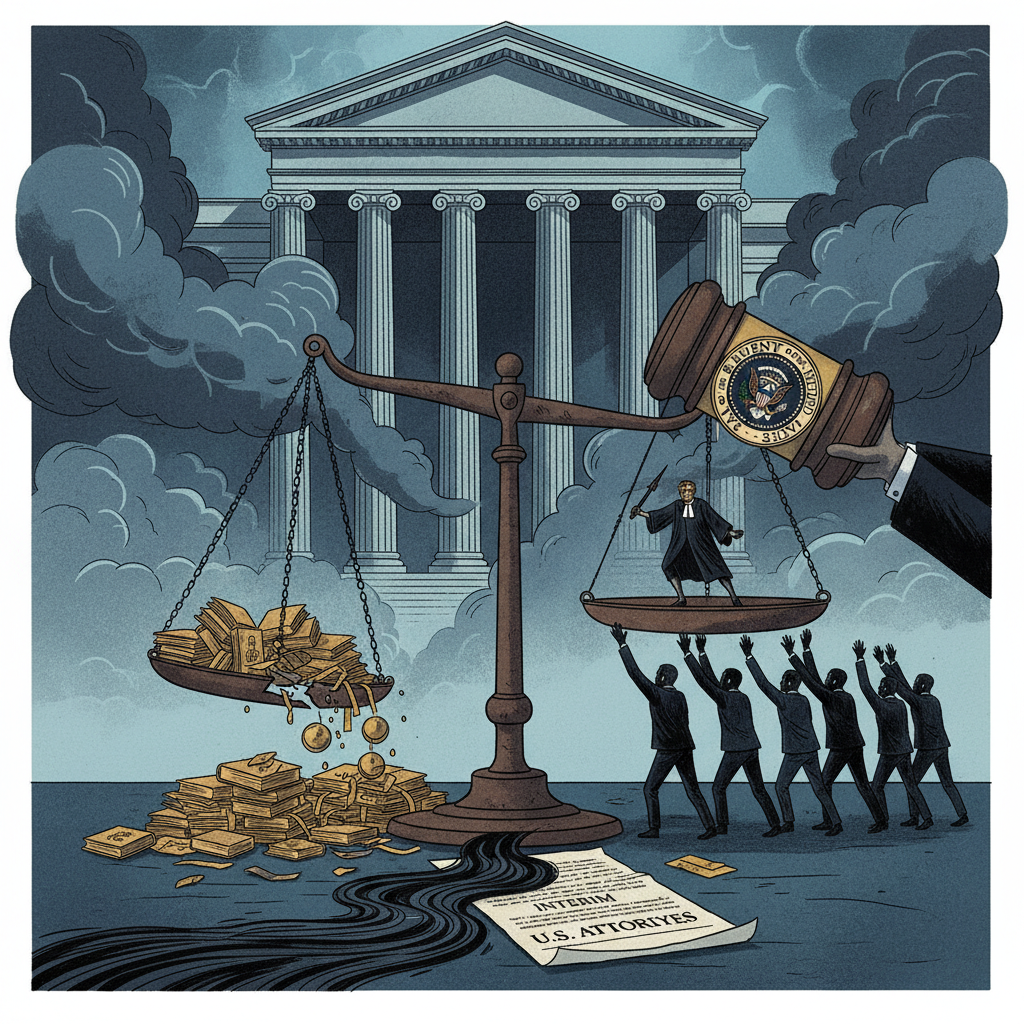
Mainstream reporting on the recent appellate hearing regarding the Trump administration’s interim appointments has focused almost exclusively on the 'mood' of the bench. By highlighting that judges 'seem skeptical' or 'expressed concerns,' the press prioritizes judicial theater over legal mechanics. This approach frames a complex statutory dispute as a character drama, casting the administration as a deviant actor while treating the court as a moral arbiter rather than a technical one.
What We Know
What the coverage failed to analyze is the interplay between the Federal Vacancies Reform Act (FVRA) of 1998 and 28 U.S.C. § 546, the specific statute governing U.S. Attorney vacancies. The narrative that the administration is simply 'bypassing' the Senate ignores the reality that these laws were crafted specifically to allow the executive branch to function when the legislative confirmation process stalls. Furthermore, the reporting misses the systemic context: the average time for a Senate confirmation has ballooned from 50 days in the 1980s to over 115 days today. The 'bypass' is not merely a choice; it is often a response to a broken appointments process that neither the media nor the courts seem interested in auditing.
What's Being Claimed
The administration relies on a dual-track authority. While the FVRA generally limits acting officials to 210 days, 28 U.S.C. § 546(c) allows the Attorney General to appoint an interim U.S. Attorney for 120 days. Crucially, § 546(d) states that if the 120 days expire without a Senate-confirmed appointee, the 'district court for such district may appoint a United States attorney to serve until the vacancy is filled.' The administration’s legal team argues that because the law provides a specific mechanism for filling these roles indefinitely (via the court), the 'advice and consent' requirement is functionally modified by statute for these specific positions. The press avoids this technicality because it complicates the narrative of simple executive lawlessness.
Data from the Government Accountability Office (GAO) indicates that the use of 'acting' and 'interim' titles has been on a steady upward trajectory for three decades. Under the Obama administration, several high-profile roles, including the Civil Rights Division head, were held by acting officials for years. The Trump administration has certainly accelerated this trend, but it is an evolution of institutional behavior, not a sudden mutation. By framing this as a unique Trump-era phenomenon, the press fails to identify a permanent shift in how the Executive branch views its own autonomy in the face of a slow-moving Senate.
This is the most significant looming question. If the court rules that John Sarcone lacked the authority to issue subpoenas, it creates a 'fruit of the poisonous tree' scenario for hundreds of active prosecutions. However, the 'de facto officer doctrine'—a legal precedent that generally upholds the actions of an official who was acting under the color of law even if their appointment is later found technically flawed—is the likely safety net the DOJ will hide behind. The media’s focus on the 'skepticism' of the judges misses the fact that the court will likely try to find a narrow ruling that avoids a systemic collapse of the federal justice system's current caseload.
What's Actually Happening
The reliance on the 'skepticism' of appellate judges is a classic symptom of authority deference. By echoing the court's framing, journalists position themselves as stenographers for the judicial branch. This 'view from the bench' reporting avoids the harder work of investigating why the Senate Judiciary Committee hasn't used its subpoena power to challenge these appointments directly. It is easier to report on a judge’s raised eyebrow than to investigate the legislative inertia that makes interim appointments necessary for the basic functioning of the Department of Justice.
The 'bypass' is not merely a choice; it is often a response to a broken appointments process that neither the media nor the courts seem interested in auditing.
Conclusion
This story is not actually about a rogue administration or a skeptical court. It is about the collapse of the constitutional 'advice and consent' process. When the Senate becomes a graveyard for nominations, the Executive will inevitably seek statutory loopholes to keep the gears of government turning. The Vacancies Reform Act is that loophole. The appellate court’s 'skepticism' may result in a temporary setback for specific prosecutors like Sarcone, but it does nothing to address the underlying incentive structure. Until the confirmation process is reformed or the FVRA is repealed, the government will continue to be run by 'acting' officials, and the press will continue to report on the resulting legal skirmishes as if they were isolated incidents of personality rather than the predictable outcomes of a failing system.
FAQ
Q: What is the Federal Vacancies Reform Act (FVRA) of 1998?
A: The FVRA is a statute that generally allows the President to appoint acting officials to temporarily fill executive branch positions for up to 210 days when nominations have not been confirmed by the Senate.
Q: How does 28 U.S.C. § 546 affect the appointment of interim U.S. Attorneys?
A: 28 U.S.C. § 546 permits the Attorney General to appoint interim U.S. Attorneys for 120 days. If no Senate-confirmed appointee is named within that period, the district court can appoint a U.S. Attorney to fill the vacancy indefinitely.
Q: Why has the use of 'acting' and 'interim' titles increased over recent decades?
A: The increase is largely due to a slowdown in the Senate confirmation process, which now takes much longer than in the past, prompting the executive branch to rely more on temporary appointments to maintain government functionality.
Q: What could be the consequences if the court rules against the legitimacy of interim appointments?
A: If interim appointments are ruled illegitimate, it could impact ongoing prosecutions due to the 'fruit of the poisonous tree' doctrine. However, the 'de facto officer doctrine' may allow actions taken by such officers to be upheld despite appointment flaws.
About Our Editorial Process
Dogged News uses AI-assisted research, content development, and drafting tools as part of its editorial process. Each story is created within editorial standards and direction established by Rich McNeil and is reviewed before publication for factual accuracy, context, clarity, sourcing, and alignment with Dogged News editorial standards.
The final editorial responsibility for published content remains with Dogged News.
Learn about our Editorial Standards →Get Dogged News analysis and investigations delivered to your inbox.
Discussion (0)
0/2000 · Comments are reviewed before publishing.
Have an account? to comment with a verified identity.
No comments yet. Be the first to share your perspective.