

Beyond the "Vassal State": The Economic and Physical Limits of the UK’s Sovereign AI Ambition
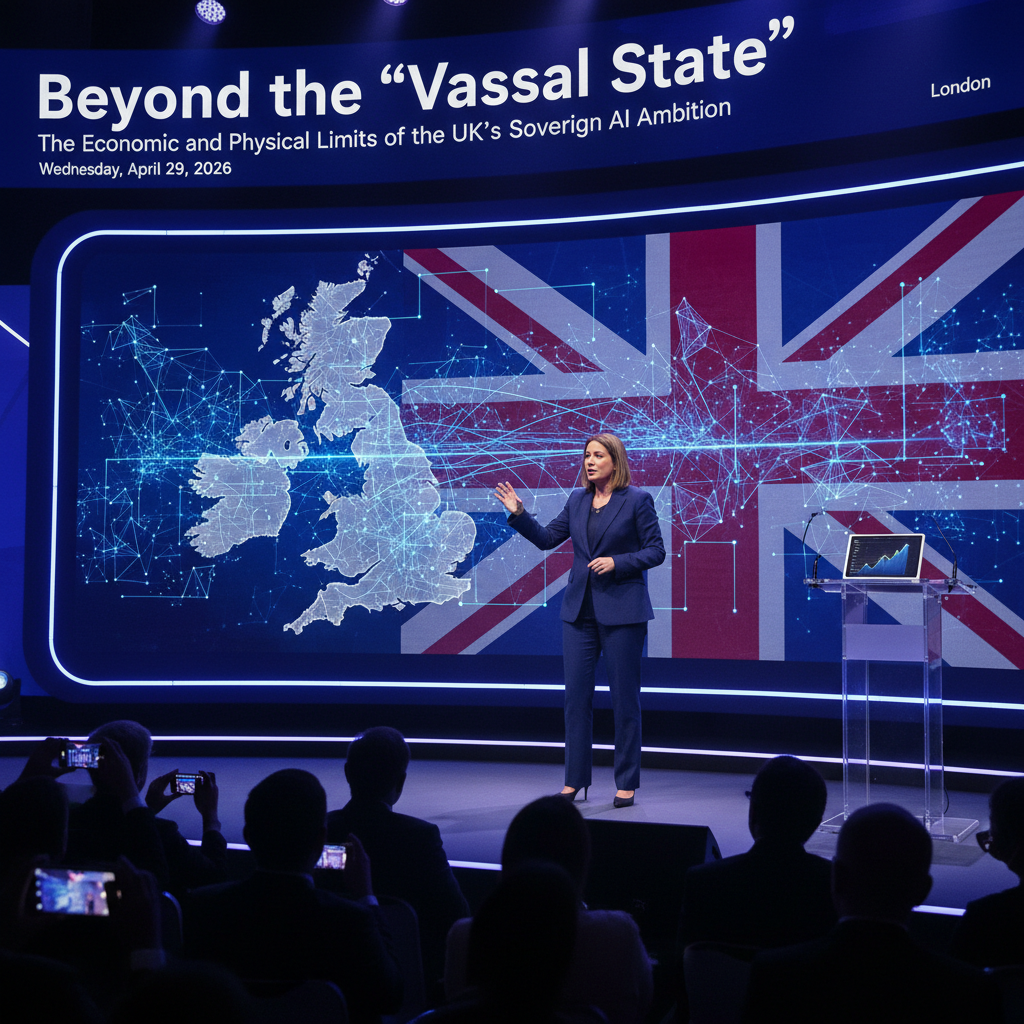
In a recent summit, UK Technology Secretary Liz Kendall utilized the kind of evocative language usually reserved for historical epics, warning that the United Kingdom risks becoming a "vassal state" to American artificial intelligence giants. The mainstream press, led by The Guardian, immediately amplified this narrative, framing the government’s desire for "sovereign AI" as an urgent survival imperative. However, by adopting the government's alarmist framing, these reports missed the fundamental disconnect between political rhetoric and physical reality.
What we are seeing is a textbook example of access journalism. By repeating Kendall’s colorful metaphors without scrutinizing the underlying feasibility, the press has transformed a complex policy proposal—one with massive implications for taxpayers and the national energy grid—into a simplified story of national pride versus foreign dominance. To understand what is actually happening, we must look past the emotive labels and examine the industrial and financial mechanics the original coverage ignored.
What We Know
The mainstream coverage centered almost entirely on the "threat" of American dependence, yet failed to mention that a truly independent AI stack is currently a physical impossibility for the UK. The press missed the fact that "sovereign" software still runs on globalized hardware. The UK does not manufacture the high-end semiconductors (GPUs) required to train large language models at scale. Whether the AI is branded as "British" or not, the underlying infrastructure remains tethered to a supply chain dominated by Taiwan (TSMC) and the United States (Nvidia).
Furthermore, the reporting failed to address the regulatory paradox. While Kendall speaks of sovereign capabilities to protect "British interests," the government has yet to explain how a state-funded AI would navigate the UK’s own stringent data protection laws without granting itself special exemptions that would be denied to private competitors. The "vassal state" narrative serves as a convenient distraction from these structural contradictions.
FAQ
Q: Is 'Sovereignty' Possible Without Domestic Silicon?
A: True technological sovereignty requires control over the entire stack, from the sand used in chips to the algorithms in the cloud. Currently, the UK is entirely dependent on foreign hardware. If the government spends billions on "sovereign AI" that runs on American-designed chips manufactured in East Asia, the "vassalage" has not been ended; it has merely been subsidized. The press failed to ask how a national strategy can be "sovereign" when the physical means of production are entirely beyond national control.
Q: Can the UK’s Aging Energy Grid Support This Ambition?
A: AI data centers are notoriously energy-intensive, requiring massive amounts of electricity and water for cooling. The UK’s National Grid is already facing significant strain as it attempts to transition to renewable sources. Experts have warned that new data center applications in West London and the M4 corridor are already facing multi-year delays for grid connections. Kendall’s plan for homegrown infrastructure requires a massive increase in baseload power that the current UK energy strategy has not accounted for. No one asked the Secretary where the gigawatts for this "sovereign" future would actually come from.
Q: Which Corporate Interests Are Positioning for the Subsidies?
A: Whenever a government uses the language of national emergency to justify a "coordinated national strategy," the most important question is: cui bono (who benefits)? A national AI strategy involves billions in public procurement. While Kendall frames this as a battle against US tech giants, it is highly likely that the primary beneficiaries will be a handful of well-connected British defense and tech firms. The press neglected to investigate which companies have been lobbying for this centralized approach and what their specific ties to the current administration might be.
Conclusion
The "vassal state" rhetoric is a political tool designed to justify massive public spending and centralized control over a sector that has, thus far, been driven by private innovation. By framing the issue as a choice between national sovereignty and foreign subjugation, the government bypasses the necessary debate over the opportunity cost of these billions.
The reality is that technological independence in the 21st century is not achieved through slogans, but through energy surplus, hardware manufacturing, and a regulatory environment that fosters genuine competition.
Ultimately, this story is not about resisting American influence; it is about the UK government attempting to pick winners in a high-stakes global market using taxpayer funds. Without addressing the energy constraints, the hardware dependency, and the actual cost to the public, the promise of a "sovereign AI" remains a political fiction rather than a technological roadmap.
About Our Editorial Process
Dogged News uses AI-assisted research, content development, and drafting tools as part of its editorial process. Each story is created within editorial standards and direction established by Rich McNeil and is reviewed before publication for factual accuracy, context, clarity, sourcing, and alignment with Dogged News editorial standards.
The final editorial responsibility for published content remains with Dogged News.
Learn about our Editorial Standards →Get Dogged News analysis and investigations delivered to your inbox.
Discussion (0)
0/2000 · Comments are reviewed before publishing.
Have an account? to comment with a verified identity.
No comments yet. Be the first to share your perspective.